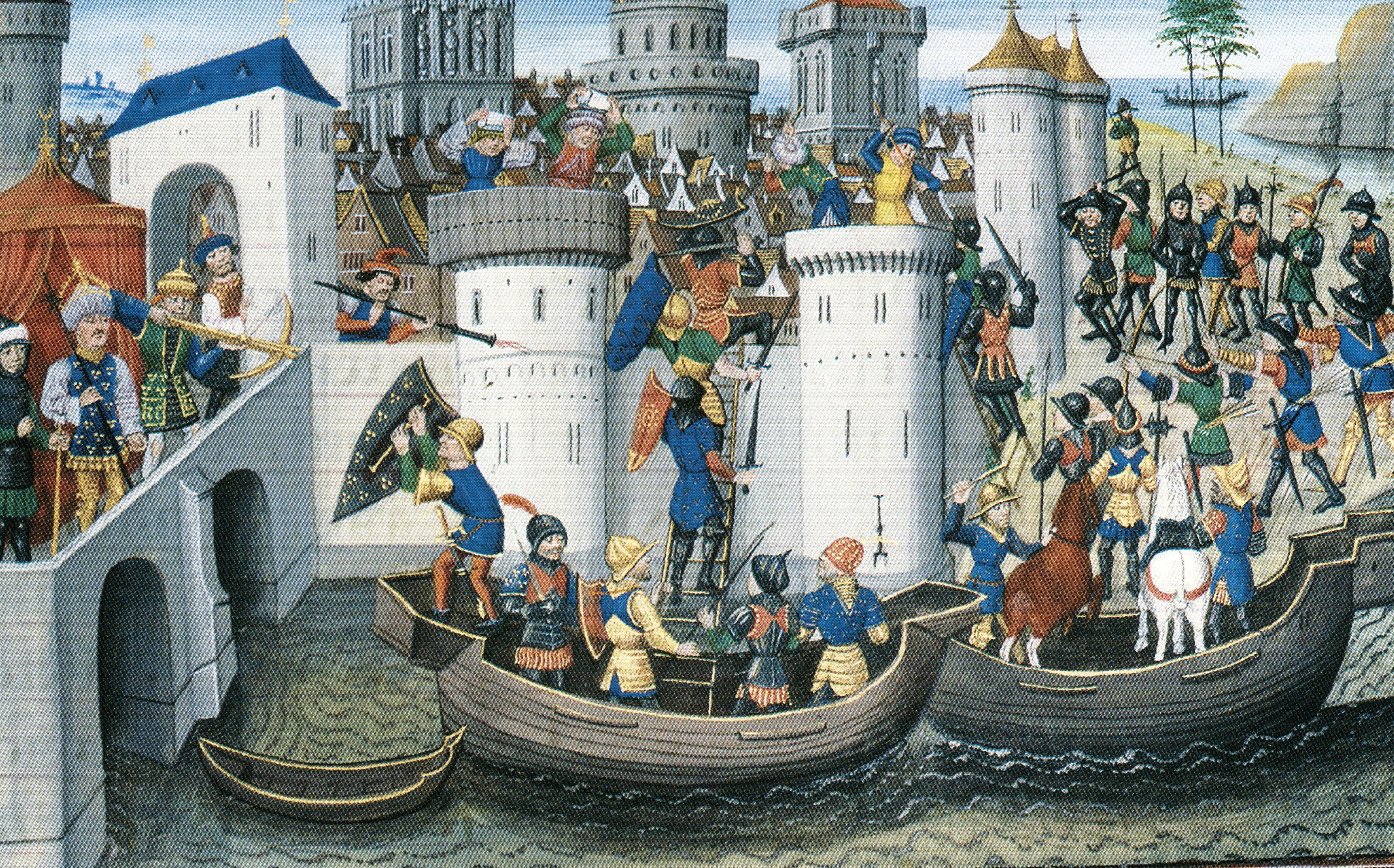
The Siege of Constantinople
Few things in life go as planned, fewer things however, go as poorly as the Fourth Crusade. With an ending perfect for someone who enjoys dark humor, The Fourth Crusade is probably the most ironic of all the Crusades. Originally conceived as a response to the failed Third Crusade, or at least its perceived shortcomings, it inevitably did more damage to Christendom than no Crusade at all by further dividing Catholicism and Orthodoxy, hasting the decline for the Byzantine Empire, and never having reached Muslim held territory or the Holy Lands.
The First Crusade began with a call for help from Constantinople and when the Fourth Crusade captured the city in 1204 and then disbanded in 1205, it a served as a dark ironic bookend to quests for the Holy Land.
Innocent III began forming the idea of the Fourth Crusade in the late 1190s, but the aftereffects of the Third Crusade (ended 1192) were still producing problems. Richard the Lionheart of England and Phillip Augustus of France were still heating up the Angevin/Capet war over France, a war which despite Richard’s death in 1198/9 didn’t end til 1214. Being one of the largest reasons the Third Crusade failed (the other being the death of Frederick Barbarossa), the Angevin/Capet argument continued to disrupt possible recruitment for the Fourth Crusade. In fact the largest recruitment out of England and France were nobles who found themselves choosing the wrong side, and found a Holy War thousands of miles away extremely convenient. The Cistercuan monk Alberic wrote about 50 years later saying that recruitment was “an overseas expedition of nobles … who had formally abandoned King Phillip when King Richard attacked”
When Richard died it allowed an easy out for parties on both sides to take up the cross and get out of the decades long fray. Unfortunately for England, and as it turns out Innocent III, John (Richards brother and successor) was a horrible monarch and not a general at all. England needed all the military power it could muster just to keep itself together and it still came to a crushing defeat in 1214, not at all in the position to offer up troops to a Crusade in 1204.
In order to help incentivize the crusade, Innocent III called upon Richard and Phillip to make peace in 1198 via Post miserabile, his first Crusade letter, and asked that they, especially Phillip, contribute mercenaries to the crusade. Obviously, neither listened. To sweeten the deal, Innocent III made significant changes to the idea of remission of sins and helped birth the idea of indulgences. The First Crusade had already been unique for offering the remission of sins in exchange for violence against the heathen, now Innocent took it one step further by offering remission of sins to anyone who simply joined the crusade and tried, by declaring a simple act of will was enough rather than action. This produced noticeable effects in recruiting and paved the way for the selling of indulgences in the 16th century. Geoffrey of Villehardouin who was present for both the planning and execution of the Fourth Crusade and is one of the handful of eyewitness accounts, wrote “Because the indulgence was so great, the hearts of men were much moved, and many took the cross for the greatness of the pardon.” With money and nobles still not coming in like Innocent wanted, he established a church wide tax of roughly 2.5 percent via Graves orientalis terrae. This created a massive church wide tax gathering operation with the direct intent of funding a crusade.
Since major nobles were proving hard to secure, Innocent instead turned to recruit from the minor baronies and the lay folk, focusing on the populations of France, England, and some of the German lands. Using a tactic that had been successful before but never quite so employed, he recruited the 12th century equivalent of celebrities and had them preach his recruitment message. This in turn proved to be rather successful in recruiting people, although lagged somewhat in raising funds, a problem that wasn’t limited to the Fourth Crusade, but would come back to haunt it later.
While the majority of recruits were coming from what is today modern France, some recruits were coming from as far away as Ireland. Germany, which had been by far the largest contributor during the Third Crusade under Fredrick, barely had any contributions at all. This is in large part due to the succession war triggered on Frederick’s death, which largely would leave the German Empire, aka The Holy Roman Empire, shattered until Frederick II came onto the scene in the early 1220s, upon who’s death the state largely unraveled until the Prussian Federation in the early 18th century. While this was detrimental to Crusading and the welfare of the German state, it would benefit the Reformation three centuries later In the 1500s.
Other than the Venetians, who were less recruited and more…tag longs (a story we’ll get to in a minute), the largest demographic appears to have been the Dutch. Also called “lowlanders” or the older “Frisians”, the Dutch came largely from Brabant and Flanders.This may have been to avoid being called into either of two wars raging near by, the afore mentioned English/French war or the German Succession war. There may have been some hope that the success of the Crusade could lead to a more stable Frisian state or political base, allowing them to push back against the English, French, and German claims on the Dutch land. This could have been achieved if a stable hierarchy of Dutch knights and lords survived the Crusade and carried the respect of their fellow European combatants. While many distinguished themselves on the Crusade, the Crusade itself was such a disaster, no ones political fortunes were turning for the better.
The Third Crusade had been a classic follow up to the two primary Crusades before it, seize the coastal territory from Antioch to Darum and then push east to Damascus and south to Jerusalem, and like the two Crusades before it, had proven to be a slow and bloody process, often ending before reaching Jerusalem. The Fourth Crusade initially appeared to be designed to follow a similar path, but a 5 year peace treaty between the Frankish Kingdom of Jerusalem and al-Aldil, Saladins oldest living son, seems to have forced a redesign, and the new Fourth Crusade plan was one designed to address the short comings of the first three Crusades.
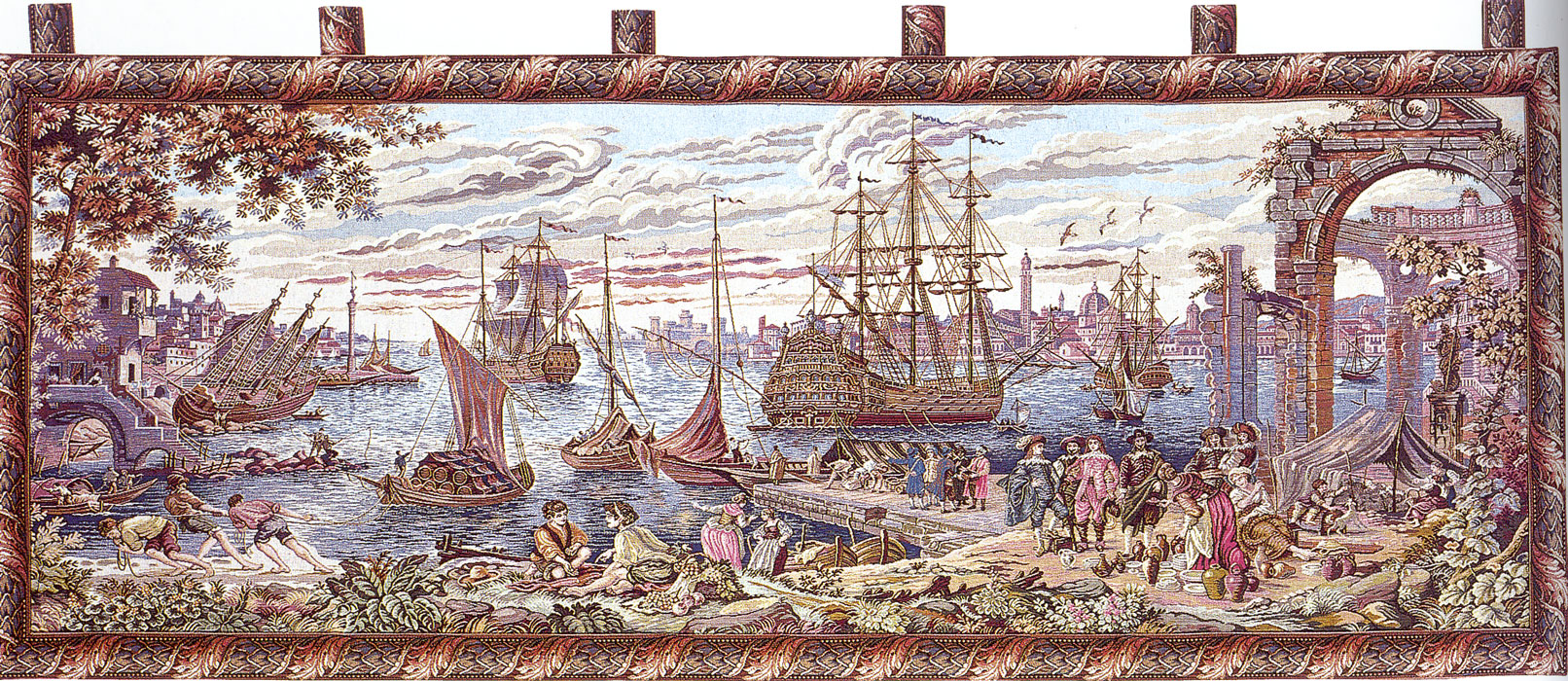
A 16th century depiction of Medieval Venice
Egypt had been the breadbasket of the Ancient world for thousands of years and in the Middle Ages it wasn’t any different. Egypt also had a legacy of being a major cultural, educational, and religious center for Christians, Muslims, and Jews, and it was thought that if you attacked such a vital artery in the Muslim held lands, Jerusalem would be easier to take. The plan was actually laid out really well. Not only would it allow Crusading troops to bypass thousands of miles of marching through more or less hostile territory just to get to the Muslim held lands, it also removed the need to take large baggage trains and/or force troops to forage for supplies. All the supplies, troops, and arms could be loaded onto ships and sailed over. The Pope himself was something of a siege enthusiast and designed a number of vessels that were designed to sail up to the coastal fortifications with siege towers and rams built on top of them and mow down the coastal forts. There were also troop transports designed to take troops from the ships to the shore line, and they looked very much like the kind of PT boat the allied forces used when landing at Normandy in 1944.
Unfortunately (a word used a lot when talking about the Fourth Crusade), The Papal numbers suggested for a Crusade of this magnitude, about 33,500 men and 4,500 horses, suggested a fleet larger than anything in existence at the time, about 50 galleys + an unknown number of flat bottom barges carrying provisions for 9 to 12 months. To build such an enterprise the Pope looked to the trader cities in Italy. Genoa less than tactfully turned down the Pope. Genoa had lost its entire fleet in a costly war with Florence about 10 years earlier, a war in which the Pope refused to force a peace due to his financial connections with the Florence.
Venice however, agreed to create the fleet and add 50 of its own war galleys at its own cost for the princely sum of 100,000 Marks. In order to do this, the entire city had to stop all of its commerce and all of its other industrial endeavors and focus solely on the creation of the Crusade fleet for over year, which obviously would put the city in a bit of a financial bind. The delegates to the city politely balked at the suggested sum, reminding the Doge that the sum requested was equivalent to decades of income for the rest of Europe. After consulting the lords of the city, the Doge of Venice agreed to 90,000 Marks, to be paid over the completion of the fleet. Additionally, Venice would be granted first pick and 50% of all spoils of war and would receive large portions of Cairo after Egypt had been taken.
Unfortunately, designing a war to fight the previous one has generally never worked well, and the same held true here. As mentioned, one of the great stumbling blocks to the Third Crusade was the cold war/open fighting between England and France, another had been Saladin. Saladin was the ultimate leader of the Arab Empire, and at the time the Third Crusade showed up, Saladin controlled West from North Africa, North into modern Turkey, and East over into Arabia. He was extremely popular, greatly skilled, well educated, and very driven.
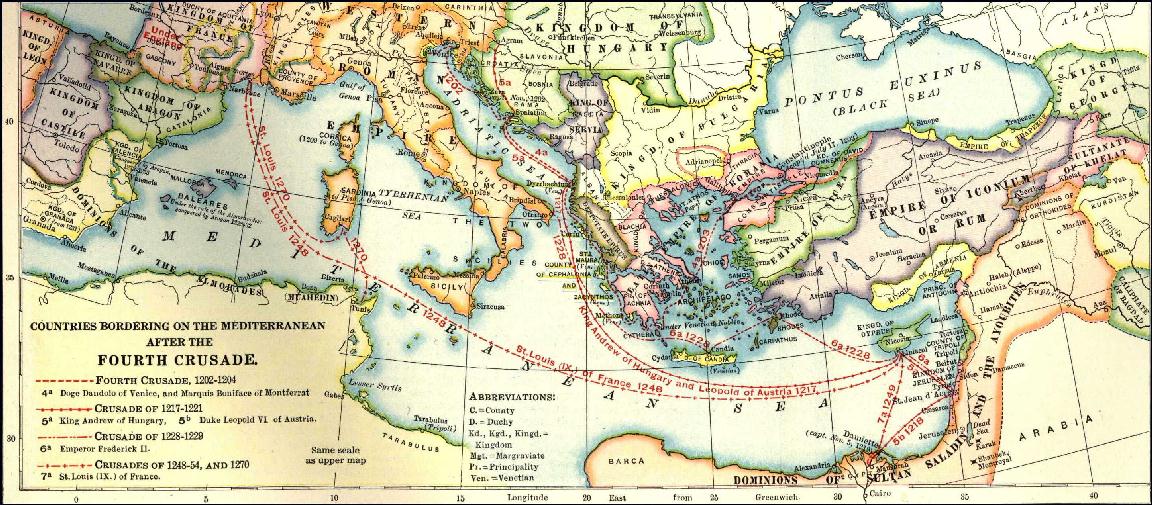
World view at the time of the 4th Crusade. The Egyptian lands in the south were the target, while the path in the north is the fateful journey
When the Third Crusade disbanded in 1192 it had no way of knowing that Saladin would die in 1193. If it had, Richard and Phillip might of put aside their squabble… or perhaps not. Either way, a Third Crusade with no Saladin would have made far more progress. While you might think that having him out of the way for the Fourth Crusade would be a good thing, it in fact wasn’t. The Crusader strategy was designed against attacking a single, large Muslim Empire with all of complications and internal politics large organizations have, when in fact it was now several smaller kingdoms all fighting for claims over the others. The faction/Son of Saladin that held Egypt was actually the most West accepting one of the lot. Having managed successful and regular trade with Genoa, Venice, Almafi and other Italian Trader Cities, he was more than open to the idea of supporting a Western Crusade against his rivals who held Damascus and Jerusalem.
The Irony is, that a weaker Ayyubid in Egypt, IE one just partially conquered by crusaders, would strengthen the other Islamic kingdoms in the region. To say nothing about the low odds of the Crusaders holding on to Egyptian territory. The First Crusade had shown that after a Crusade it took considerable wealth, coordination, and time to administer and hold on to new lands, and to date the best the Crusaders had managed was a slow loosing war of attrition. Splitting the local resources between a new Crusader Kingdom and a Trader City would have only further reduced the odds of success, unless the Venetians had been willing to really financially invest and help turn the taken land into a medieval North Korea.
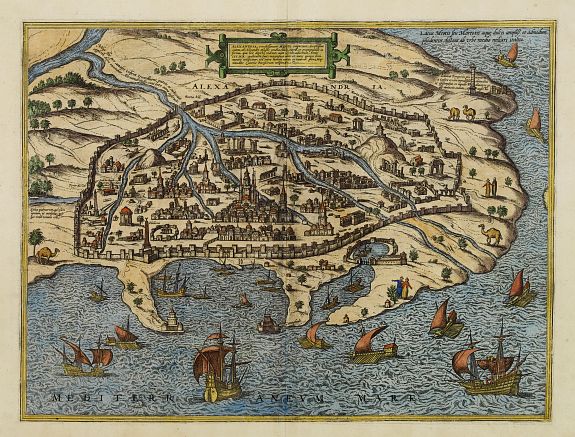 The new target of the Crusade appears to have been poorly kept, with the celebrity preachers out and out saying that Alexandria was the target. Being the key shipping port, it was a natural target for the Crusade, and when word reached the Sultan of the forecoming attack, he tried to buy the Venetians off. He need not bothered, since little of the Church wide tax had been collected by 1202, and recruiting was still down, but perhaps in retrospect, the Venetians should have let him. Those that had pledged to join the Crusade had already committed a princely sum of 20,000 marks to the cause, and were now finding funding themselves and their retinues difficult to maintain, to say nothing of the thousands soon to be pouring into Venice to gather for the crusade. By autumn of 1202 less than a 1/3 of the 35,000 men had arrived, with the Crusading having planned to leave in the summer. Further complicating matters, the Crusade still owed the Venetians some 35,000 marks, and many of those arriving came with barely a shirt of their back, having been told that all would be provided for them when they arrived. The Venetians were not in a charitable mood, nor in the position to offer much, having dedicated their entire economy to building the navy for the Crusade, and began trying to extort sums of money from the arriving masses, and turning away those that could not pay. When that failed, they threatened to cut off supplies to the Crusades who were camped on the isle of Lido. The Doge of Venice then came forward with a suggestion that would change the fate of the Fourth Crusade.
As we’ll see in Part 2 things quickly spiraled out of the Popes control, and entered an even great chaotic state.
Note: For those interested in the value of marks, you can see a break down of Medieval currency in a blog here (as soon as I edit it)
 Chronicles of a Rainy Day Historian