Our Father, which art in heaven, hallowed be thy name. Thy Kingdom come, Thy will be done, on earth as it is in heaven. Give us this day our daily bread, and forgive us our trespasses, as we forgive others. And lead us not into temptation, but deliver us from evil, and save us oh lord, from the wrath of the Northmen. For thine is the Kingdom, the Power, and the Glory, for ever and ever. Amen.
Where we last left off with Scandinavia, we were just at the start of the Viking age and while it might seem odd to start a conversation about Vikings with a copy of the Lords Prayer, it actually makes sense once you know the context. For those of you who grew up hearing the Lords Prayer, you might have noticed the somewhat different ending. For the rest of you, i’ve included it in BOLD. One does not casually edit the literal words of the Son of God, especially in an age that was so religiously fervent, but that’s exactly what happened here. The only motivator that can properly explain this sort of edit, is the deep and extreme fear of ones mortal and spiritual self. Exactly the kind of fear the Vikings inspired in Europe.
So why so much fear? We set the stage for an understanding of the Vikings with our introduction last time, and this time we need a small primer on 8th century Europe, before we can follow the Vikings plunge into history.
Now I fully plan to do a series on Medieval Christianity, but basically what you need to understand is that Europe at this point is largely driven by religious ideology and motivations. To that end, most of the laws and logic were based on Deuteronomic logic, which is to say laws and mentality driven by the laws in the Old Testament, or the Medieval perception of the laws in the Old Testament.
In the Old Testament, when the Israelites stayed from God, God tended to punish them. This punishment followed a repeating style over time:
1. Israel is punished with diseases and plagues.
2. Israel is punished with droughts and storms.
3. Israel is punished with invading armies from the North.
This last one is especially important. Conquerors almost always beset Israel from the North, and it became a frequent motif in prophecies and parables. So to the Medieval mindset, if God was going to punish the Christian peoples, it would follow something like the above.
There were a number of events going on inside the Church (The Catholic Church), Christianity, and Secular Kingdoms in the 7th and 8th centuries that lead a large persistent belief that the Christian population as a whole were living in sin, and that punishment would soon be upon them.
Most people are familiar with the later Plague outbreak that Europe would suffer, but there was also earlier outbreaks. In the 5th century Plague swept out from Muslim controlled Egypt, up to the Byzantine (or still called Eastern Roman Empire at this point) capital of Constantinople, and ravished Eastern Europe. Over the 6th and 7th centuries waves of the Plague would sweep across Western Europe, attacking populations there.
At this point, this could either be a judgement from God, or a visit from the Devil.
Writings from the early 530s in Byzantium (Greece), Gaul (France), Italy, Ireland, and even Japan, all mention horrible droughts that beset the local populations. Death of crops, loss of life stock, and death of the old and young are all frequently mentioned. The Annals of Ulster mention there was “a failure of bread across the land”, while the writings of Mohammad and the inheritors of his empire, mention at the beginning of the Muslim conquest the drying up of Oasis’s frequently used by travelers and armies
These trends continued on and off and rotating through various regions up through the 8th century. Modern science, using carbon 14, and 16 analysis, dendrochronology (study of tree rings), sedimentary layers (layers within dirt), and study of polar ice corings (like tree rings, but ice) all show that world as whole suffered a drought during the 500’s, and this trend continued for Europe up to the 600’s, and Western Europe up to the 800’s.
To top it all off, Western Europe was also plagued by violent storms in the 700’s. France and Frisia (kingdom of the Dutch, roughly Holland and Belgium) experienced massive flooding. Northumbria (Northern England), Pictland (Scotland), and Dal Riata (Irish Kingdom of Western Scotland), all experienced thunderstorms, fires, and floods.
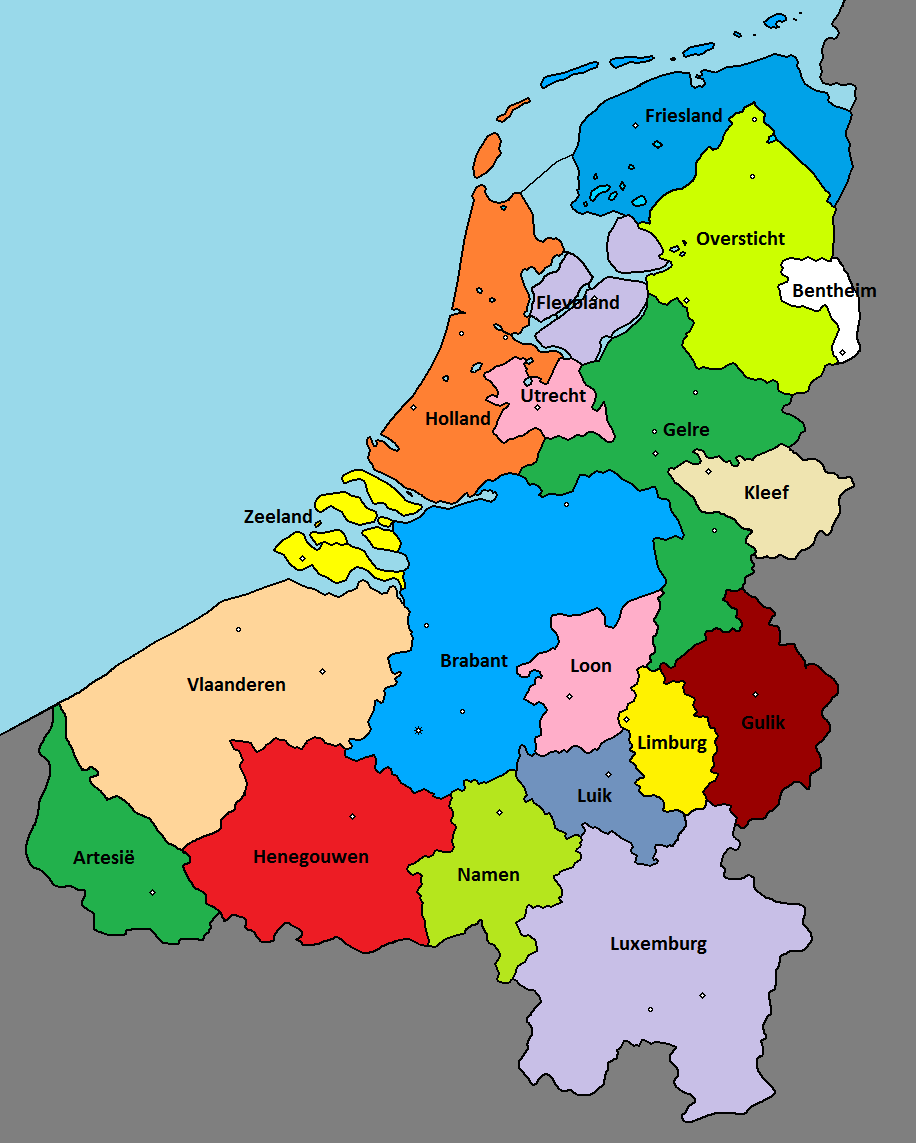
With the exception of Luxemburg, this represents most of the counties in the Kingdom of Frisia, even though the Kingdom itself only lasted for about 70 years, the region and the people continued to be call Frisia/Frisians. Today, Frisia exists in bits of France and Germany and in the Dutch countries of Belgium and Netherlands.
So again, another onset by Satan, or punishment by God? This gives rise to my favorite passage from the Anglo-Saxon Chronicle, and brings up back on topic:
“A.D. 793. This year came dreadful fore-warnings over the land of the Northumbrians terrifying the people most woefully: these were immense sheets of light rushing through the air, and whirlwinds, and fiery dragons flying across the firmament. These tremendous tokens were soon followed by a great famine: and not long after, on the sixth day before the ides of January in the same year, the harrowing inroads of heathen men made lamentable havoc in the church of God in Holy-island, by rapine and slaughter.”
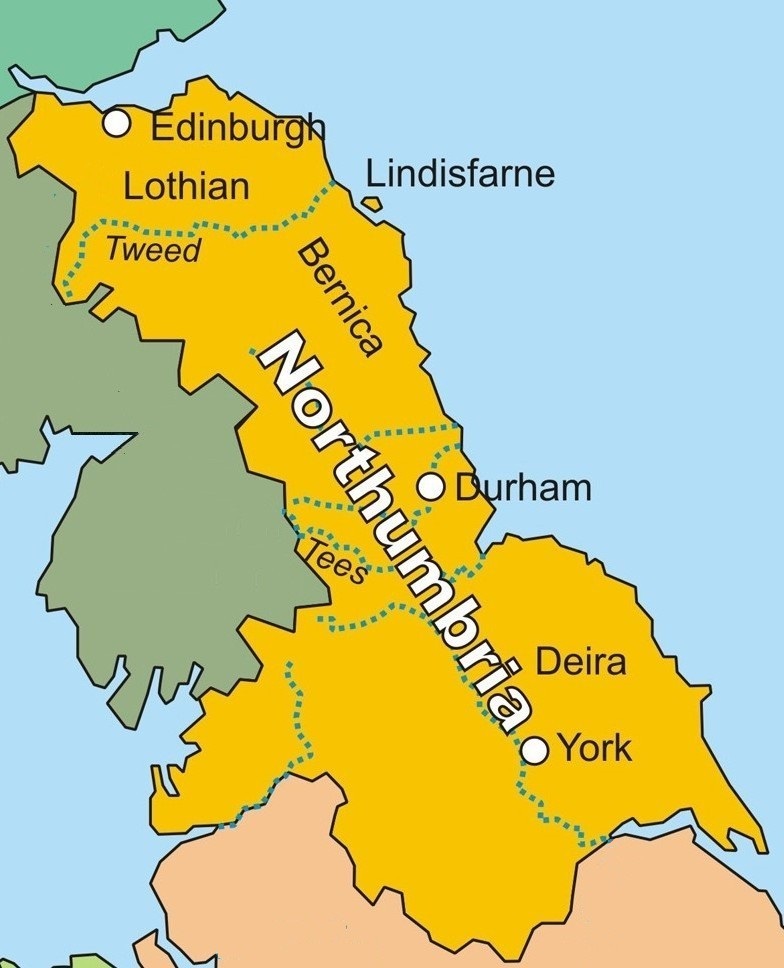
The Anglo-Saxon Kingdom of Northumbria is in the Yellow, and the Green is the Celtic Kingdoms of Strathclyde and Pictland.
And with the arrival of the Vikings, a unbelieving, heathen onslaught from the North, we have confirmation: Punishment by God. The amount of terror that suddenly starts cropping up in Prayer books, Chronicles, and Songs from the end of the 8th century on, is truly staggering.
The first confirmed/recorded arrival of the Vikings was at Lindisfarne, or as the Anglo-Saxon Chronicle listed it, the Holy Island – a name which it still goes by today. Up to this point, islands had been considered a relatively safe place to put monasteries, like the one at Lindisfarne, well out of the way of invading Romans and Germans, and out of the way of the way from the numerous boarder wars between the Germanic tribes and the Celts. The monasteries very quickly became massive deposits of Literature, Relics, Graves/bones of Saints, and wealth in the form of Sheep, Cattle, Wine, and Gold, and the arrival of the Vikings in remarkably nimble boats challenged and threatened all of that.
The likelihood that the Vikings arrived out of the fog randomly at the Monastery of Lindisfarne is rather remote. Prior to 793 the Vikings possessed a healthy trading networking (largely limited to Germany), and it would make sense that some part of that network reached to Anglo-Saxon England, and that they learned of English politics and religious customs. There’s also indications that the Northmen had been called upon at points for their skill as craftsmen and architects, which would have also included those same political and religious centers. Whatever the reason, the Vikings did show up, and they did raid the monastery.
As the Vikings left with everything they could carry, they left in their wake a stunned, paranoid, fear laden, England (and soon Europe), that couldn’t see any way of stopping the invaders. For the Vikings, they finally saw a way out of the cycle that so many of them had been trapped in. No longer were they forced to keep recycling the wealth already in Scandinavia, nor limited to what trading they could get with German merchants. They had confirmation of large sums of wealth, relatively easy to access, and a people who were absolutely terrified of them.
and so the Viking age had begun….
Look forward to next time as we delve into the early Viking raids of Scotland, Ireland, England, and France.
Also coming down the pipe (and I promise not all of this will be so long winded):
Viking invasion of Celtic lands
Viking invasion of England
Viking invasion of France
The Viking trading network east into Russia
The discovery of Iceland
Greenland and Vineland
Vikings, Constantinople and the Varangian Guard
Viking Burials
Viking Swords
Viking Boats
Runestones and graffiti
Genetic inheritances
Misc Tales from the Viking age
Rise of Christianity and the end of the Viking age
 Chronicles of a Rainy Day Historian